
Execution the Reliable ROI Lever
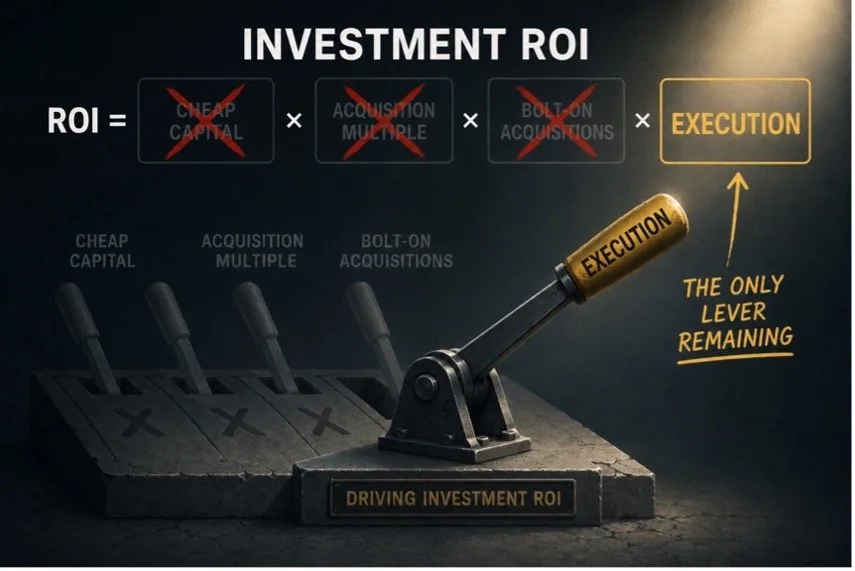
Cheap capital used to do the heavy lifting for owners and investors. With the cost of capital up two- to three-fold, execution is what's left to create value.
For most of the last decade, owners and investors could lean on cheap capital to do a lot of the work. The mechanisms for rich exit multiples and returns were heavily influenced by cheap capital. Lower interest rates facilitating higher multiples, enabling a planned de-levering over time and higher gearing ratios.
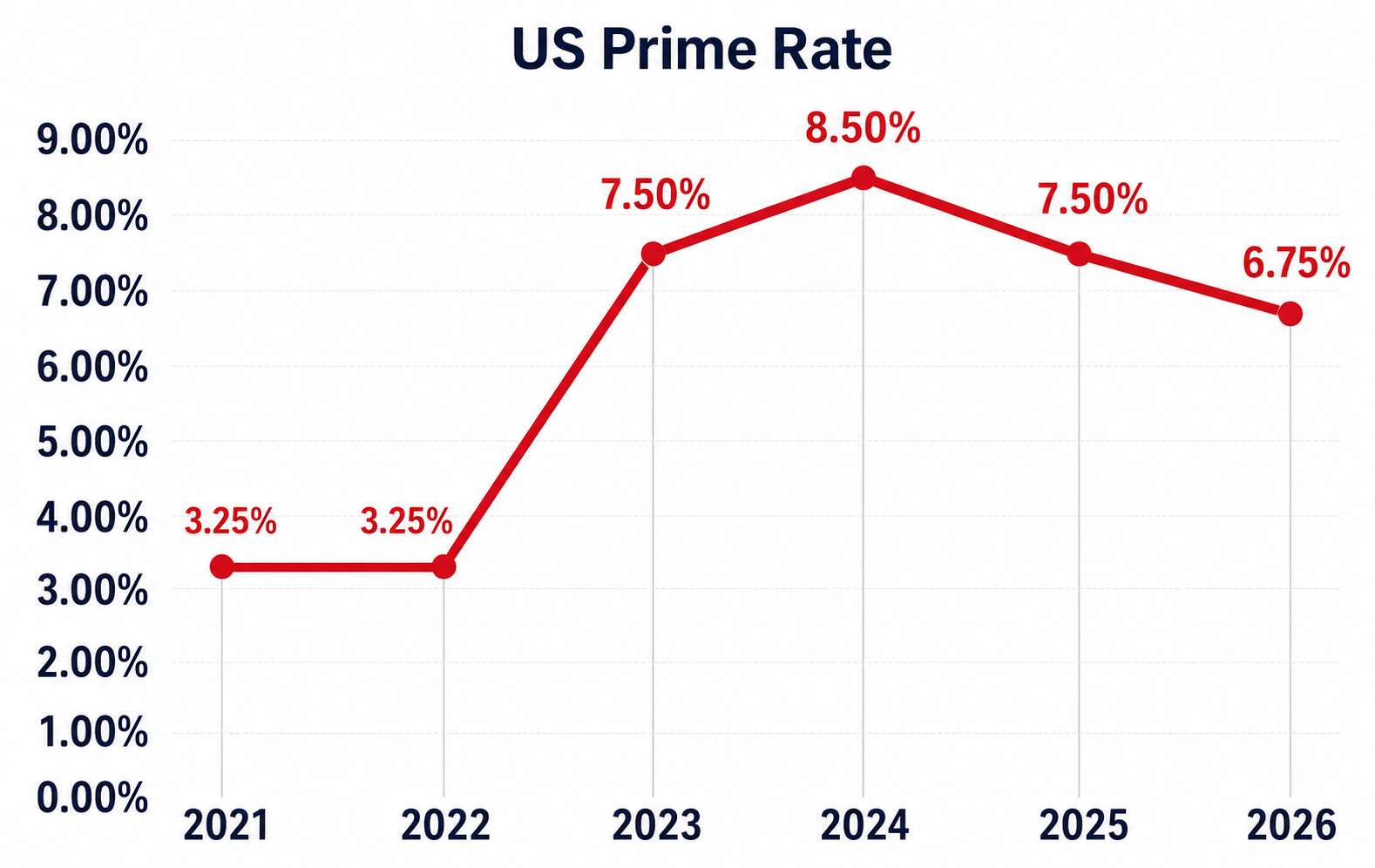
Businesses that were acquired in the United States before 2022, were typically financed on much lower interest rates. For most businesses, these rates are long gone and have doubled or nearly tripled in the past few years.
There has never been a time in history, where managerial execution was not critical. The current environment has removed other levers previously available to owners and investors. Chiefly among these has been three decades of very low cost of capital.
When interest rates are lower it is an enabler of multiple expansion that is countered by anticipated, quick deleveraging. The abundance of inexpensive debt was used to fund a larger share of the purchase; lessening the need for equity infusion, increasing acquisition or sale multiples. This was under-pinned by softer bank covenants, which have eroded or disappeared in recent years.
In recent months, a private equity client was addressing the very problem. They rolled up over a dozen smaller businesses and used debt to finance the acquisitions. The debt was always significant, now exceeding $110 million dollars, but it was offset by more robust EBITDA performance. When acquiring the companies, the EBITDA allowed for a planned net debt / EBITDA ratio below 3.5x. The business was now suffering with much lower EBITDA and a 16x’s gearing ratio. Many businesses are facing this challenge today.
We had a similar problem at Manitex International. Although our EBITDA increased significantly from $8M to $36M, we found that ½ of our EBITDA was being absorbed in debt servicing. Our cost of capital doubled from 2022 to 2024, creating an enormous headwind.
Investors cannot change inflation or Fed policy. Execution remains the only lever that can be pulled.
Summary Points
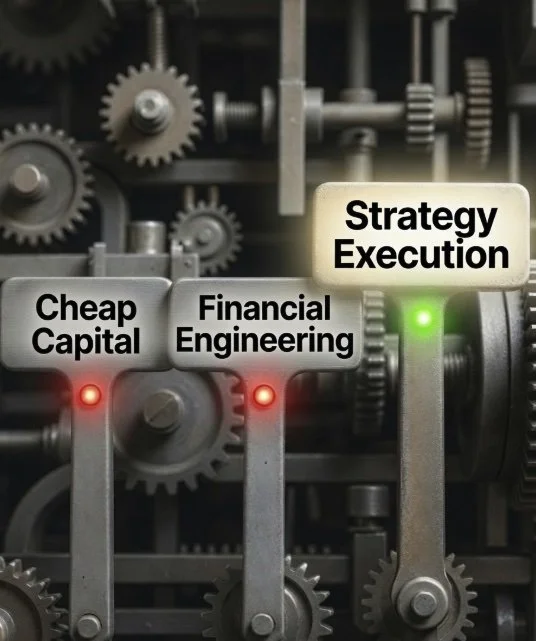
• Cheap capital used to be a legitimate lever for value creation. With the cost of debt up two- to three-fold, that lever is largely closed — execution is what's left.
• EBITDA growth has always been the objective. What's changed is the only way left to get there: disciplined, bottom-up execution against a shared strategy.
• Good execution needs a good tool. The Balanced Scorecard is that tool and a mechanism that can align the team, close the gaps between strategy and value and supply feedback that can facilitate repeatable improvements.
• G.A.L.E. Force — Global Aim, Local Execution — is the operating model behind this: strategy set top-down, results delivered bottom-up.
Strategy Execution – the most reliable path to EBITDA
EBITDA growth has always been the objective; that isn't new. What is new is that owners and investors can no longer count on financial engineering to get there. Margin has to be built, not borrowed. And margin isn't built by a single decision at the top — it's built by hundreds of decisions made across the organization every day, by people who will never see a term sheet.
That is the real pivot: not EBITDA as the goal — it always was — but execution as the only remaining path to it.
The CEO as Conductor
Strategy is set from the top. It has to be — someone has to decide where the business is going and why. But results are always heavily influenced by bottom-up execution. The CEO's job is not to perform the strategy; it is to conduct it — to make sure every section of the organization understands the score, is playing on time, and is empowered to make the calls in front of them without waiting for permission from the podium.
Owners and investors should evaluate a CEO less on the strategy presented and more on the execution system built underneath it. A brilliant strategy with no execution engine is a plan. A strategy paired with disciplined, bottom-up execution is value creation.
The Engine Dashboard
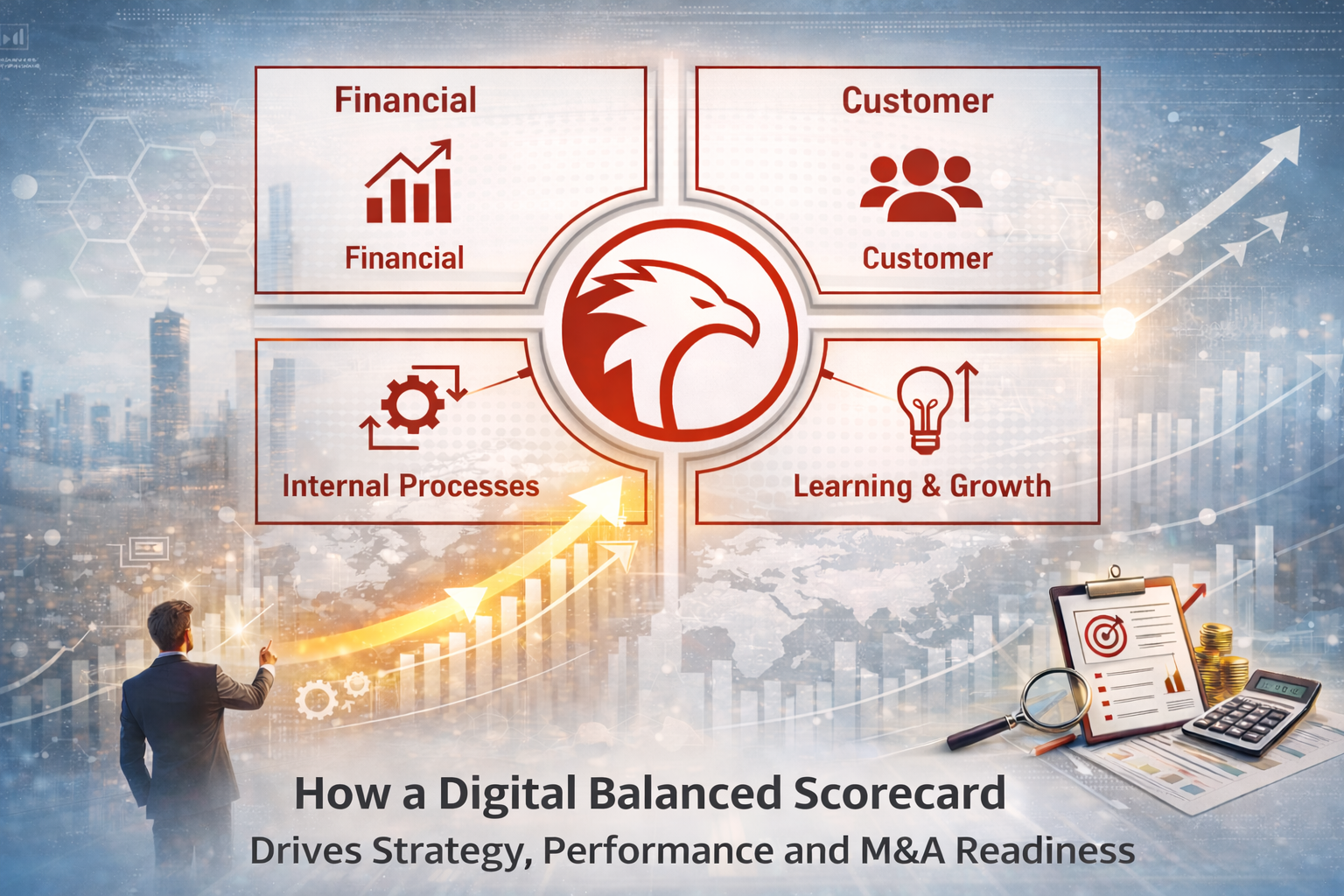
This is where the Balanced Scorecard earns its place — not just as a reporting tool, but as an alignment tool. Properly integrated, it does four things at once:
• Aligns the team around a shared definition of what matters most
• Focuses daily efforts on the handful of drivers to attain your strategic goals
• Early detection - Surfaces marginal improvement early enough to compound it, rather than discovering it after the quarter closes
• Connects growth, margin, people development, and customer outcomes into one causal system rather than four competing priorities
Marginal improvement, sustained and repeated, is what EBITDA growth looks like from the inside. It rarely arrives as a single event. It arrives as a hundred small corrections, caught early and compounded — which is exactly what a well-run scorecard is built to do.
Case Example: Manitex International
Michael Coffey, former CEO and I saw this play out directly at Manitex International, a global manufacturer operating in seven countries that was underperforming its peers by 6–7 margin points. The strategy, “Elevating Excellence,” was set at the top. The improvement came from the bottom: KPIs were unified across international locations and standardized into a common framework; data from three ERP systems was consolidated; reporting frequency moved from monthly to weekly; and operational KPIs were tied directly to financial outcomes.
Local teams, not corporate directives, closed the gap — because they finally had a shared scorecard telling them where to focus. The result wasn't a single quarter of improved margin. It was a repeatable system for producing it.
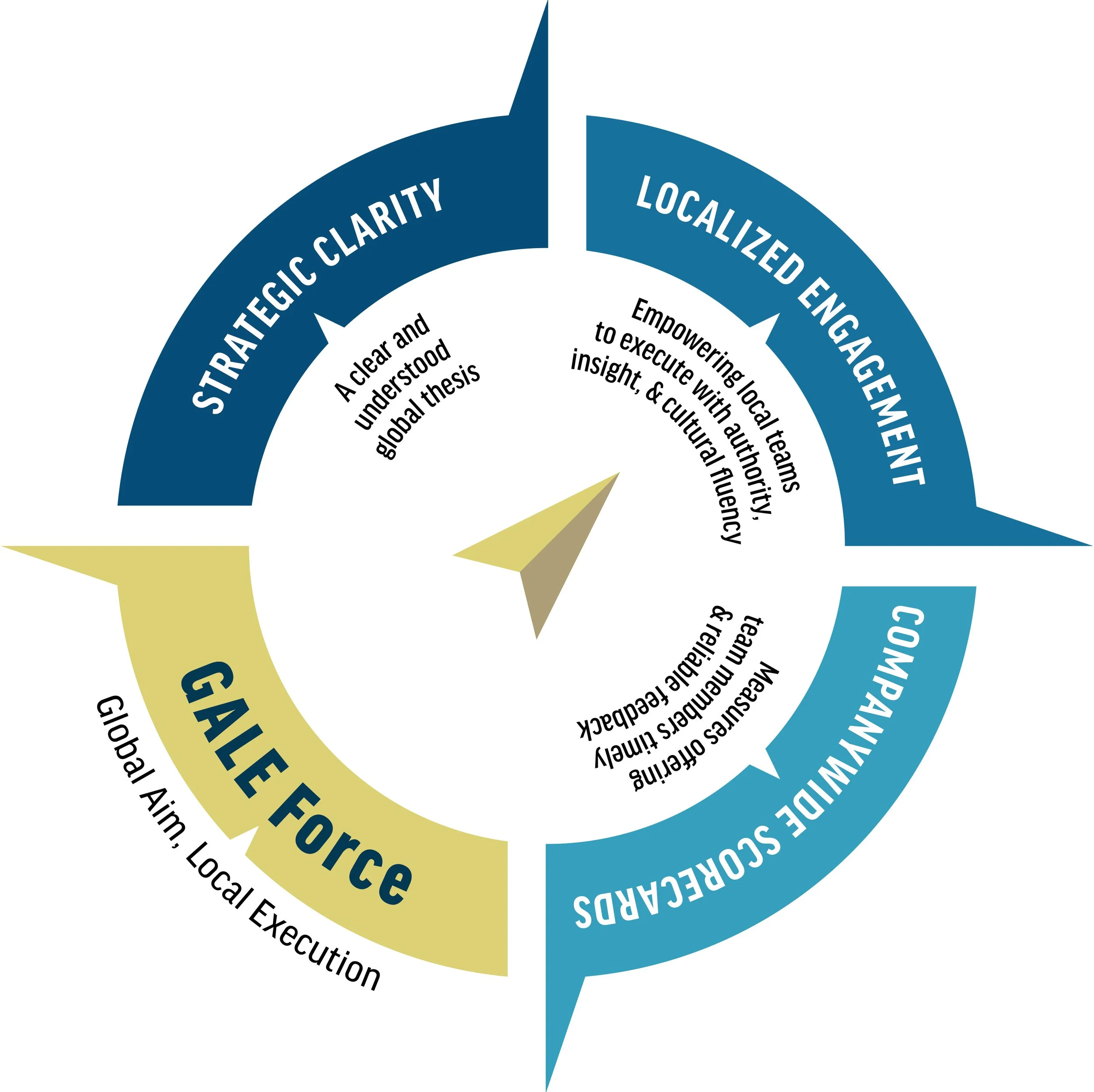
GALE Force - Global Aim, Local Execution
This same principle sits at the center of G.A.L.E. Force — Global Aim, Local Execution — the framework built from two decades of running and selling multinational manufacturing businesses. Strategy is global: it has to be set with a clear, consistent aim from the top. Execution is local: delivered by the teams closest to the customer, the plant floor, and the P&L, empowered to act with authority, insight, and cultural fluency.
For owners and investors, the implication is direct. In a higher-cost-of-capital environment, the businesses that outperform are not the ones with the boldest strategy — they are the ones whose local teams can execute it, consistently, without corporate having to intervene.
More on the G.A.L.E. Force framework is available at www.jmichaelcoffey.com and www.resurgenceadvisory.com.
Questions Every Owner | Investor Must Answer
· Is your team focused on the right activities
· Is the cadence of measuring key indicators correct
· Is the organization aligned well enough
· Has accountability been adequately established
The Balanced Scorecard can facilitate this and drive executable results more reliably. A properly integrated Balanced Scorecard won't manufacture EBITDA overnight — but within weeks it will tell you whether your organization is capable of the repeatable, bottom-up execution that a doubled or tripled cost of capital now demands.
That capability — not the multiple you paid or the leverage you used — is what determines whether value is created or merely borrowed.
Author – Amiel Orquiola VP Resurgence Advisory
About Resurgence Advisory
The team at Resurgence Advisory has completed 38 M&A transactions and uses advanced business analytics, digital dashboards, and Balanced Scorecard frameworks to convert strategy into execution — and execution into value.
If you're an owner or investor ready to move from reporting performance to driving performance, let's talk.
Message us for a free consultation