
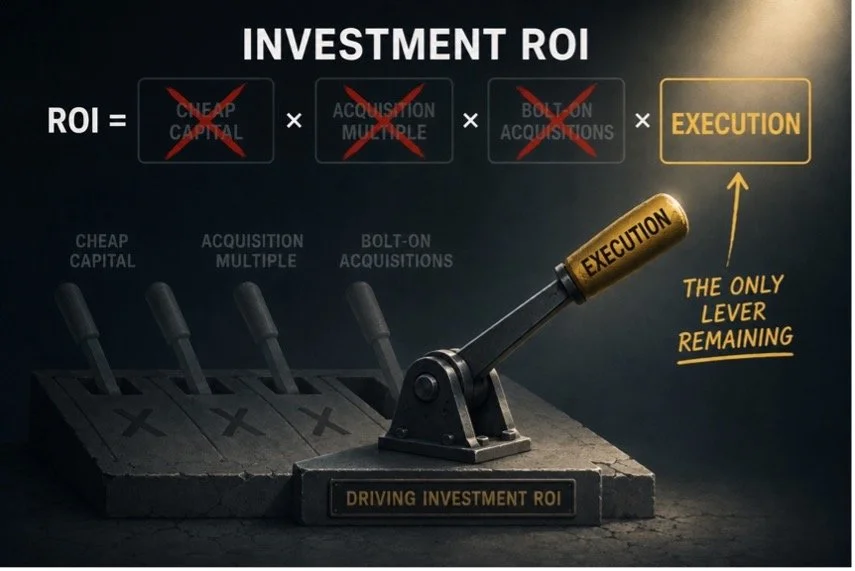
Execution the Reliable ROI Lever
EBITDA growth has always been the objective; that isn't new. What is new is that owners and investors can no longer count on financial engineering to get there. Margin has to be built, not borrowed. And margin isn't built by a single decision at the top — it's built by hundreds of decisions made across the organization every day, by people who will never see a term sheet.
That is the real pivot: not EBITDA as the goal — it always was — but execution as the only remaining path to it.

INDEPENDENCE DAY – Selling your Business
Top questions business owners must ask prior to contemplating an exit.

Beyond the Scoreboard
In too many organizations, the CFO is reduced to a sophisticated scorekeeper—tallying results, producing reports, and calling fouls after the fact. Like a referee watching the game from the sideline, they observe outcomes but rarely shape them. This is a costly misalignment of talent and a missed opportunity for the business.
The most effective CFOs are not referees. They are coaches, players, trainers, and advisors—simultaneously. And when paired with the right strategy execution framework, like a digital Balanced Scorecard, their impact multiplies across the entire organization.

The #6 Factor That Kills #1 Deals
Culture is unmistakably critical to post-merger integration and deal performance. Yet, it struggles to gain prominence during deal assessment and diligence. There is a disconnect between the ranking of culture pre-close and post-close. The #6 factor often becomes the #1 obstacle to deal success.
Ask ninety-five percent of executives whether culture matters to the success of an acquisition, and they will say yes without hesitation. Then ask them to rank their top diligence priorities, and culture will land sixth or seventh — well behind financial quality, strategic fit, market position, risk, and legal. The variance in strategic importance is not hypocrisy. It is a rational response to what can be measured easily.
We have watched this pattern repeat in transaction after transaction. Financial models are defended to the decimal point. Legal exposure is dissected clause by clause. Market share is triangulated across three commercial diligence providers. And then the day after closing, a management team departs, a customer relationship unravels, two operating cultures collide over transfer pricing, and the value the deal was supposed to create begins to evaporate — not because the financial model was wrong, but because no one modeled the cultural frameworks the financial model depended on.
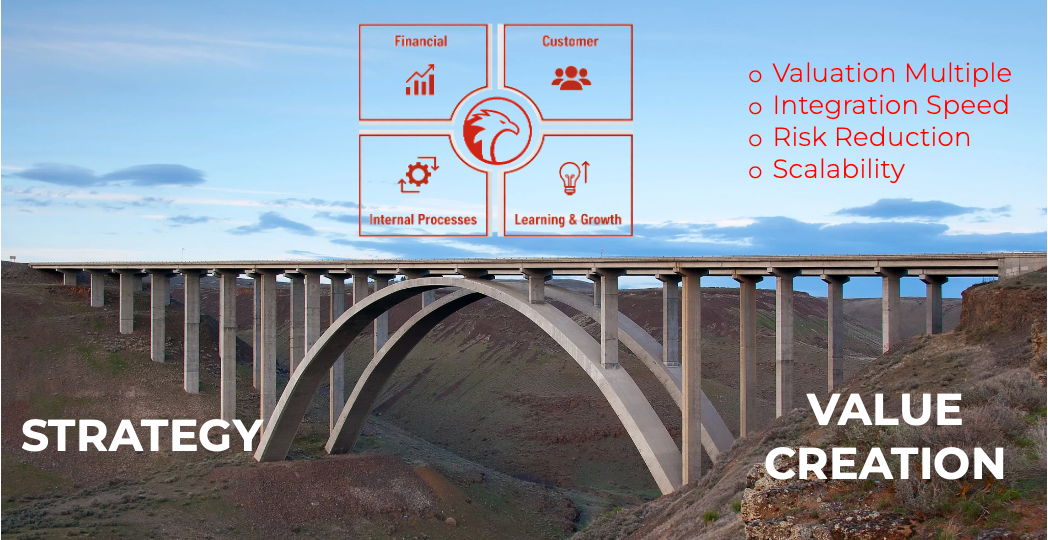
THE BALANCED SCORECARD AS AN M&A STRATEGIC ASSET
The most valuable companies are not always the fastest-growing ones. They are the ones that know why they are growing—and can prove it.
One of the most important—and most frequently underestimated—dimensions of the Balanced Scorecard is the compound effect of sustained implementation. A company that has operated with a well-functioning BSC for three to five years has not merely collected better data. It has built a different organization.
Managers have learned to see problems earlier and act on them faster. Cross-functional teams have developed the habit of shared accountability. Frontline employees have internalized the connection between their daily actions and company-wide outcomes. The feedback loop between strategy and execution has become a natural rhythm rather than a periodic exercise.
This compounding matters in M&A for a simple reason: buyers are not just acquiring the trailing twelve months of financial performance. They are acquiring the organization that produced it—and their confidence in whether that organization can produce it again. A BSC-equipped business makes that case more convincingly than one that can only point to historical results.
For sellers, the implication is clear: the time to implement a Balanced Scorecard is not six months before a transaction. It is an ASAP timeline — so that the discipline has time to compound, the metrics have time to improve, and the story of the business is written in sustained performance, not last-minute preparation.

KNOWN, INCLUDED and HEARD
In his book The Truth about Employee Engagement, Patrick Lencioni identifies three root causes of job misery:
o Anonymity—the feeling of being invisible or unknown.
o Irrelevance—not understanding how one’s work matters to others.
o No feedback—being unable to tell whether one is succeeding.
These are not personality issues or cultural deficiencies. They are structural failures that any organization can correct with intentional leadership and the right tools.
The Balanced Scorecard, properly designed and shared with the broader team, answers all three. Its four perspectives—Financial, Customer, Internal Process, and Learning and Growth—create a complete operational picture that, when communicated consistently across the organization, makes anonymity, irrelevance, and a lack of feedback structurally difficult to sustain. The question is not whether the BSC can advance employee engagement. It can. The question is whether leaders use it with that intention.
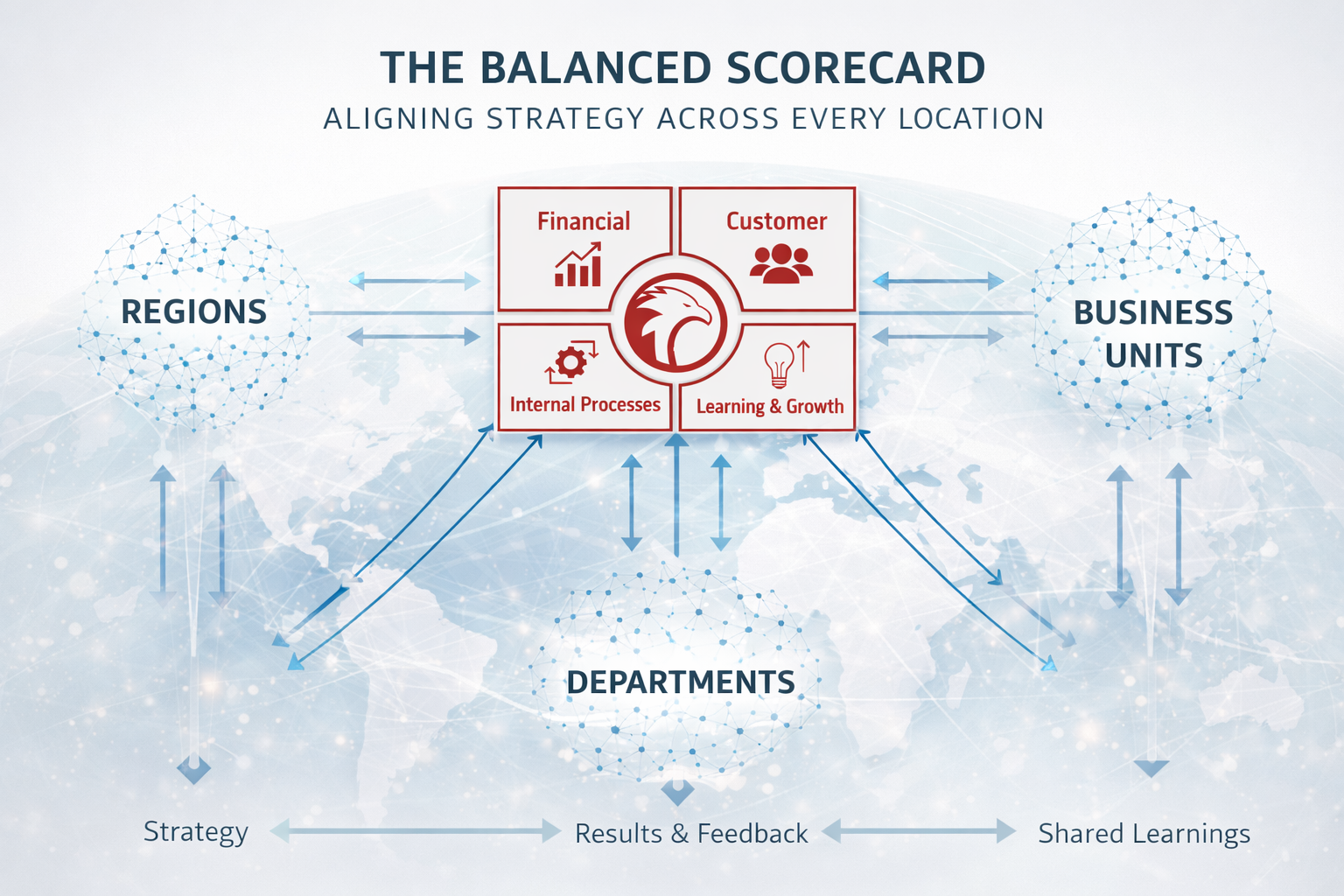
THE BALANCED SCORECARD ALIGNS MULTI-LOCATIONS
When a business operates across multiple locations, business units, or geographies, the gap between strategy and execution widens. Corporate leadership may define the direction clearly—but the message can fragment as it passes through layers of management, crosses cultural boundaries, or encounters the competing priorities of day-to-day operations.
Business Analytics and Business Intelligence can make this problem worse before it makes it better. The availability of data has never been greater. But data without structure creates noise, not clarity. What matters more than the volume of information are the questions being asked of it—and whether those questions are consistently aligned to strategic objectives at every level of the organization.
The Balanced Scorecard solves this not by adding more reporting, but by creating a structured cascade—a framework where strategic intent flows downward into measurable targets, and operational reality flows upward and across, creating a complete and connected performance picture.

FROM CHAOS TO CLARITY
In mergers, performance improvement efforts, or preparations for a potential sale, one factor consistently determines success: the quality and timeliness of information. Strategy may set the direction, but it becomes meaningful only when supported by insight that leaders can trust and act upon. This is especially true in post-merger integration, where two organizations must quickly learn to operate collaboratively.
KEY TAKEAWAYS
• Organizations in M&A or performance improvement typically move through a predictable data-maturity journey—from fragmented, delayed information to structured, timely digital dashboards that support confident decision-making.
• A digital Balanced Scorecard provides the clarity, consistency, and shared performance language needed to align newly combined teams, accelerate integration, and strengthen long-term value creation.
• Timely insight transforms strategy into execution by giving leaders real-time visibility into operational, customer, employee, and financial performance—enabling action when it matters most.

The Balanced Scorecard: Uniting Management Teams for Strategic Gain
Modern enterprises operate across geographies, cultures, and rapidly shifting markets. While corporate leadership defines global strategy, execution happens locally—through regional and functional teams focused on their own customers and operational realities. This creates a central tension: how do organizations empower local leaders while ensuring alignment with enterprise strategy?
Business intelligence (BI), analytics, and key performance indicators (KPIs) provide part of the answer. When integrated into a Balanced Scorecard (BSC), they become a unifying system—bringing clarity, focus, and alignment across management teams.
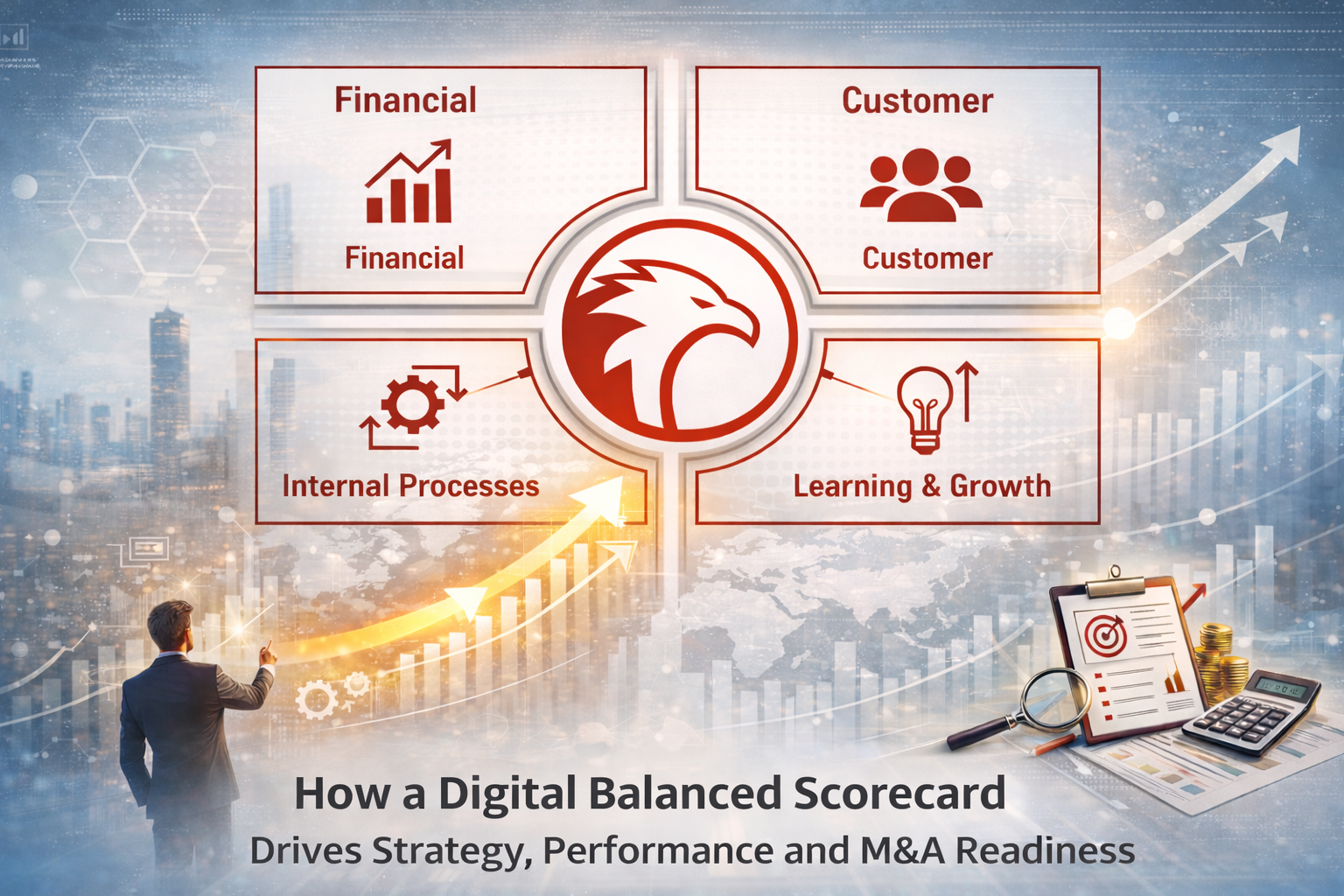
How a Digital Balanced Scorecard Drives Strategy, Performance and M&A Readiness
Whether you are preparing for M&A, navigating post-merger integration (PMI), or driving operational performance, success depends on your ability to translate strategy into measurable execution.
This is where the Balanced Scorecard becomes powerful.
A well-designed, digital Balanced Scorecard transforms corporate strategy into clear performance metrics, increases accountability, and aligns teams across locations and cultures. Most importantly, it builds the operational discipline buyers look for in acquisition targets.

How a Business Scorecard Empowers a Strategy to close the gaps between your strategy and value
Strategy without reliable, timely insight is guesswork. This is where business intelligence and the Balanced Scorecard come in.
The Balanced Scorecard developed by Robert Kaplan translates strategy into measurable outcomes. It moves organizations beyond financial reporting alone and aligns leadership around the key performance indicators (KPIs) that truly drives long-term success.