
THE BALANCED SCORECARD AS AN M&A STRATEGIC ASSET
How Analytics Discipline Transforms M&A Value for Buyers and Sellers
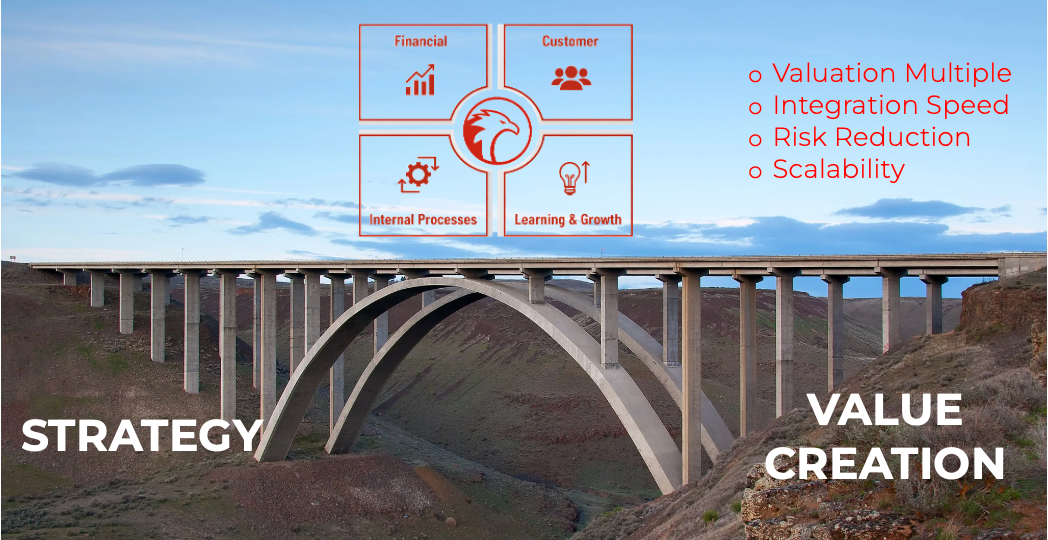
Balanced Score Card - M&A Asset bridging the gap between Strategy and Value Creation
Every transaction has a story. In some, the seller arrives with clean books, tight operations, and a management team that can articulate exactly what drives performance and why. The metrics are consistent. The dashboards are current. The strategy is envisioned and realized in the numbers. In others, the data is fragmented, the reporting is delayed, and the story of the business must be reconstructed rather than simply told.
Buyers notice the difference immediately. And they price it accordingly.
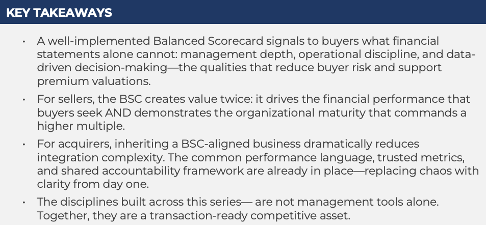
Over the course of this series, we have built the case for the Balanced Scorecard from the ground up—from why organizations adopt it, to how it drives strategy and digital performance, to how it aligns management teams, transforms data chaos into operational clarity, connects distributed operations, and draws employees into a shared mission. This final article brings those threads together for the purpose that matters most to owners, operators, and investors: creating value in a transaction.
What This Series Has Built
The six articles in this series have each addressed a distinct dimension of organizational performance. Together, they describe something larger than any one discipline: a management operating system.
The Balanced Scorecard begins as a measurement framework—four perspectives (Financial, Customer, Internal Processes, Learning and Growth) that translate strategy into measurable objectives. But when implemented with discipline, it becomes something more. It aligns management teams around shared language and shared priorities. It cascades strategic intent from the boardroom to the frontline. It transforms fragmented, delayed reporting into real-time digital intelligence. And, as we discussed last week, it ensures that every employee understands what they are contributing to, whether it matters, and how well they are performing.
Each of these disciplines matters individually. In a transaction context, they matter together—as evidence of an organization that is built to perform and built to last.
The Seller's Advantage
For a company preparing for a private equity investment, a strategic sale, or a recapitalization, the Balanced Scorecard creates value on two distinct levels.
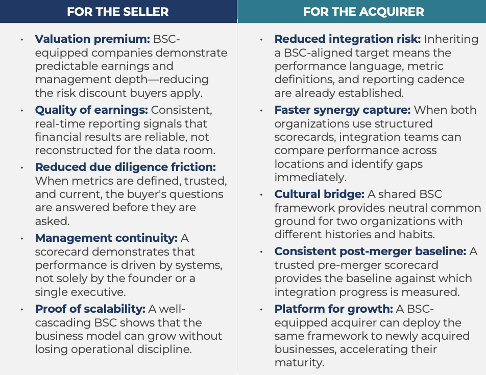
The first is performance. The disciplines the BSC instills—clear KPIs, weekly reporting cadences, cross-functional accountability, and employee engagement—directly improve the metrics that drive valuation: revenue growth, gross margin, customer retention, and EBITDA. A company that uses its scorecard well does not just look better in due diligence. It is better, because the system has been driving better decisions for months or years before the transaction.
The second is presentation. How a business presents itself in the data room matters enormously. Buyers conduct due diligence not just to verify financial results—they conduct it to assess risk. They are asking: Is this business sustainable? Is the performance repeatable? Does the management team know what drives results? A well-implemented BSC answers all three questions affirmatively before a single document request is issued.
Consider what a buyer's team sees when they encounter a BSC-equipped company: performance data that is current, not reconstructed; metrics that are consistent across locations, not reconciled at month-end; managers who can speak to leading indicators and explain variance—not just report outcomes. That picture commands a different conversation about value.
The most valuable companies are not always the fastest-growing ones. They are the ones that know why they are growing—and can prove it.
BSC Impact: Seller and Acquirer Compared
The Acquirer's Advantage
For companies that grow through acquisition, the Balanced Scorecard plays an equally important strategic role—but from the other side of the table.
The challenge of integration is fundamentally a challenge of alignment. Two organizations with different cultures, different systems, and different performance languages must quickly learn to operate as one. Most integration plans fail not on strategy, but on execution—on the inability to establish a shared understanding of what success looks like and how it will be measured.
An acquiring company that has implemented a digital BSC carries an integration playbook into every deal. The performance framework already exists. The metric definitions are established. The reporting cadence is in place. When a newly acquired business is brought into that framework, it has a clear structure to orient around—not a blank page to fill.
Equally important: an acquirer that encounters a BSC-aligned target is inheriting a business that has done the hard work. The performance language is in place. The cultural expectation of measurement and accountability has been set. Integration begins not from chaos, but from a foundation of shared structure—and that difference can be worth months of integration timeline and meaningful synergy capture.
This is not theoretical. As we described, organizations move through a predictable data-maturity journey—from fragmented and delayed information, through a structured transition, to fully integrated digital intelligence. Acquirers who bring both their own BSC discipline and the capacity to accelerate that journey in a target organization are acquiring not just assets but momentum.
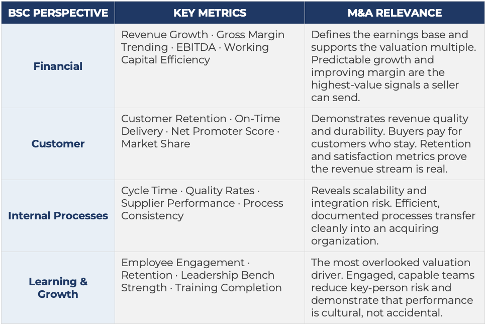
The Metrics That Drive Valuation
Not all metrics are created equal in a transaction context. The BSC's four perspectives, each of which has been explored throughout this series, map directly to what sophisticated buyers examine in due diligence:
The Compound Effect: From Better Data to Better Outcomes
One of the most important—and most frequently underestimated—dimensions of the Balanced Scorecard is the compound effect of sustained implementation. A company that has operated with a well-functioning BSC for three to five years has not merely collected better data. It has built a different organization.
Managers have learned to see problems earlier and act on them faster. Cross-functional teams have developed the habit of shared accountability. Frontline employees have internalized the connection between their daily actions and company-wide outcomes. The feedback loop between strategy and execution has become a natural rhythm rather than a periodic exercise.
This compounding matters in M&A for a simple reason: buyers are not just acquiring the trailing twelve months of financial performance. They are acquiring the organization that produced it—and their confidence in whether that organization can produce it again. A BSC-equipped business makes that case more convincingly than one that can only point to historical results.
For sellers, the implication is clear: the time to implement a Balanced Scorecard is not six months before a transaction. It is an ASAP timeline — so that the discipline has time to compound, the metrics have time to improve, and the story of the business is written in sustained performance, not last-minute preparation.
For acquirers, the implication is equally clear: the platform companies they build should embody this discipline, so that every acquisition can be integrated into a system that is already working.
CASE EXAMPLE: MANITEX INTERNATIONAL
Operating across five countries with three separate ERP systems, Manitex faced a 6–7 point margin gap versus peers.
A Balanced Scorecard aligned to the strategy, Elevating Excellence, unified KPIs across international locations into a single measurement framework.
Reporting frequency moved from monthly and quarterly cycles to weekly digital dashboards—giving managers real-time visibility into decisions and outcomes.
Horizontal information flow across regional sourcing teams—enabled by the BSC cascade—identified procurement synergies no single unit could have captured alone.
Frontline employees, for the first time, could see directly how their daily actions influenced production velocity, customer satisfaction, and profitability.
The result: record financial performance—and an organization with the management depth, metric transparency, and operational discipline that acquirers and investors prize most.
Analytics as a Strategic Asset—Not Just a Management Tool
There is a meaningful distinction between companies that use analytics to manage performance and companies that have converted analytics into a strategic asset. The first group monitors results. The second group uses analytics to drive them—and to signal something important to the market.
A Balanced Scorecard, properly implemented, crosses that line. It is no longer just a reporting mechanism. It is evidence of management depth. It is the integration playbook written in advance. It is the quality-of-earnings argument made visible. It is the employee engagement strategy embedded in daily performance feedback. It is, in short, everything that sophisticated buyers look for and that sophisticated sellers should be building toward.
This is why the Balanced Scorecard is the connective thread across this entire series—not because it is the most technically sophisticated tool available, but because it is the most organizationally powerful. It connects strategy to execution. It connects leadership to frontline. It connects today's decisions to tomorrow's results. And in a transaction context, it connects the story of what a business has been to the credible promise of what it can become.
Final Thought
At Resurgence Advisory, we have completed 38 transactions. We have sat on both sides of the table—as operators building performance systems before a sale, and as advisors helping acquirers integrate businesses that were not yet ready to be integrated. The pattern is consistent: the companies that command the best outcomes are the ones that treated performance management as a discipline long before anyone was watching.
A well-designed Balanced Scorecard—cascaded through the organization, reviewed with discipline, and used with genuine intention—is one of the most powerful investments a leadership team can make. Not because it makes the business look better in a data room, though it does. But because it makes the business be better: more aligned, more accountable, more responsive, and more valuable.
That is the promise this series was written to explore. And it is a promise that, in our experience, the Balanced Scorecard consistently keeps.
J Michael Coffey
About Resurgence Advisory
The team at Resurgence Advisory has completed 38 M&A transactions and uses advanced business analytics, digital dashboards, and Balanced Scorecard frameworks to drive measurable performance improvement. With over 30 years of experience, we help organizations turn complexity into clarity—and strategy into measurable results.
If you are preparing for a transaction, navigating post-merger integration, or seeking to implement a digital Balanced Scorecard, we can help. Contact us for a free consultation:
Schedule a free consultation: https://www.resurgenceadvisory.com/appointments