
KNOWN, INCLUDED and HEARD
A Scorecard Approach to Employee Engagement may save you from shipwreck.

courtesy - USA Today
On March 26, 2024, the container ship Dali lost power twice in quick succession as it approached the Francis Scott Key Bridge in Baltimore. With no propulsion and no steering, the vessel struck one of the bridge’s support columns. The bridge collapsed in seconds. Six construction workers on the bridge died. The National Transportation Safety Board investigated for twenty months. Its conclusion: a single loose signal wire—improperly installed, never seated properly and caused two successive electrical blackouts that made the collision unavoidable.
The wire, properly installed, would seat into a terminal block. The installation failed due to improper wire-label banding use. It was a small error with catastrophic consequences, and it persisted because no one found it.
Maintenance, by its nature, requires protocols and proactivity—someone looking closely enough to catch what is wrong before it fails, and someone invested enough in the outcome to act on what they find. Neither happened. All systems require good protocols. However, good systems are dependent upon good people, engaged in their work that the necessary precision and care may result. On the Dali, that chain broke quietly, long before the bridge did.
Most organizations will never face consequences of that magnitude. But the underlying dynamic is not rare. Employees disengage not because they do not care, but because no one has made clear what they are contributing to, whether it matters, or how well they are doing.
A well-designed Balanced Scorecard addresses all three of these deficits directly—not as a side effect, but by design.
The Three Roots of Engagement
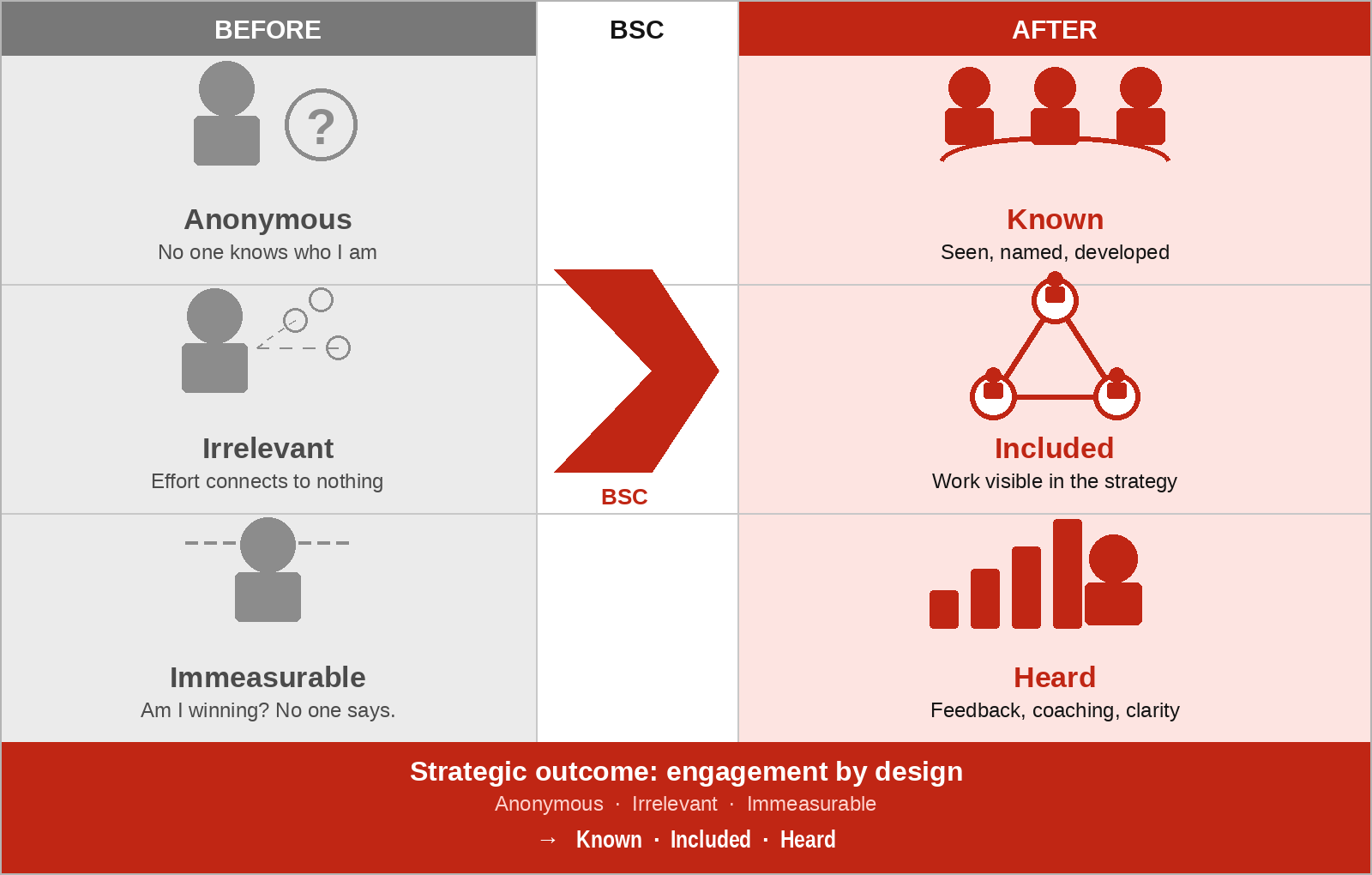
In his book The Truth about Employee Engagement, Patrick Lencioni identifies three root causes of job misery:
o Anonymity—the feeling of being invisible or unknown.
o Irrelevance—not understanding how one’s work matters to others.
o No feedback—being unable to tell whether one is succeeding.
These are not personality issues or cultural deficiencies. They are structural failures that any organization can correct with intentional leadership and the right tools.
The Balanced Scorecard, properly designed and shared with the broader team, answers all three. Its four perspectives—Financial, Customer, Internal Process, and Learning and Growth—create a complete operational picture that, when communicated consistently across the organization, makes anonymity, irrelevance, and a lack of feedback structurally difficult to sustain. The question is not whether the BSC can advance employee engagement. It can. The question is whether leaders use it with that intention.
Known—The Power of Being Seen
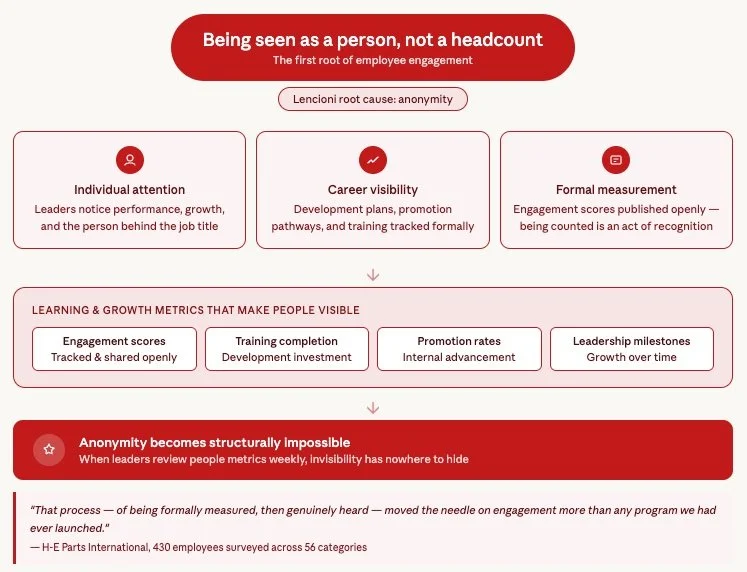
The first root of engagement is belonging—the feeling of being known. This is not about social events or forced camaraderie. It is about leadership that pays genuine attention: to individual performance, to career development, to the human being behind the job title.
The BSC’s Learning and Growth perspective is designed for exactly this purpose. When built deliberately, it includes measures of employee engagement scores, training completion rates, internal promotion rates, and leadership development milestones. These are not soft metrics. They are indicators of organizational health that compound over time into competitive advantage or competitive disadvantage.
At H-E Parts International, a global distributor of heavy equipment components, we surveyed 430 of our 780 employees across 56 categories covering operations, culture, communication, and organizational performance. Our engagement score came back at seventy out of one hundred. Not terrible, not exceptional—but honest. What mattered most was not the number itself, but what we did with it. We flew to every facility, held town halls, published the results openly, and built improvement plans together with the people who lived those results every day. That process—of being formally measured, then genuinely heard—moved the needle on engagement more than any program we had ever launched.
A quote attributed to Theodore Roosevelt, “People won’t care how much you know, until they know how much you care.”. In the end, leaders of engaged teams, care for their people.
Included—Being Drawn into the Why
The second root of engagement is meaningful work—the experience of being drawn into the why of what one does. People want to understand not merely their tasks, but how those tasks connect to something larger. When that connection is invisible, work becomes mechanical. When it is visible, work becomes purposeful.
The Balanced Scorecard’s strategy map makes that connection explicit. It shows—visually and systematically—how a warehouse supervisor’s on-time delivery metric flows upward into customer satisfaction, which flows into customer retention, which flows into revenue growth. Every link in the chain is traceable. Every team member, regardless of position in the organizational hierarchy, can see where their contribution lands.
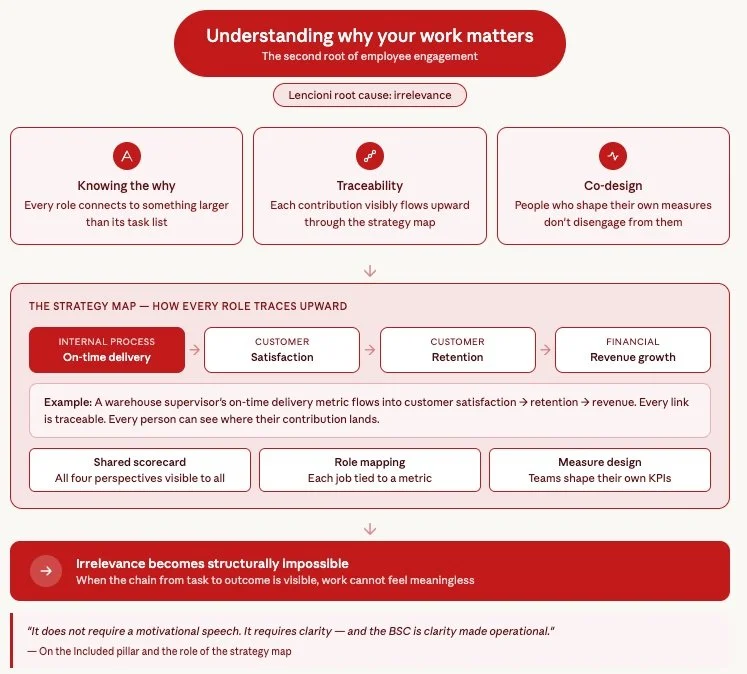
This is what Lencioni means by relevance. It does not require a motivational speech. It requires clarity—and the BSC is clarity made operational. When employees are invited to understand the scorecard, and better yet, invited to participate in shaping the measures that govern their own work, engagement follows naturally. People do not disengage from work they helped design.
Heard—Feedback as a Form of Respect
The third root of engagement is feedback. As Lencioni observes, no one wants to watch a sporting event without a scoreboard. People deserve to know how they are performing. When they are doing well, great leaders acknowledge it. When they are not, great leaders help them course-correct. Measurement, done humanely, is not punitive—it is a form of respect.
This is where the BSC’s regular review cadence becomes a cultural asset. A well-managed scorecard is not reviewed once a year in an executive offsite. It is reviewed weekly and monthly, at every level of the organization. Department managers know their numbers. Team leads know their targets. Individual contributors understand what winning looks like and where they stand relative to it.
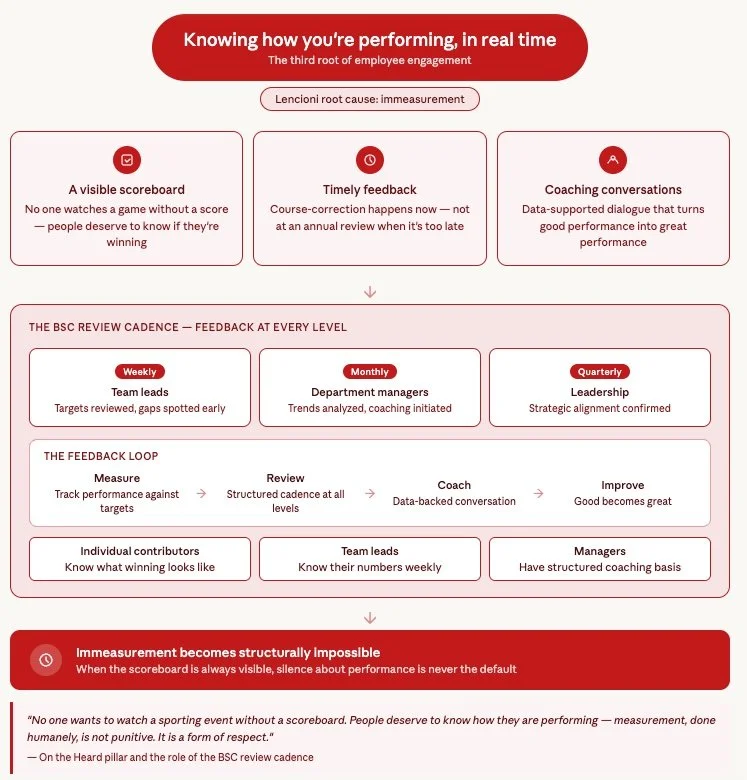
This rhythm of measurement and review creates a feedback loop that no annual performance review can replicate. Employees know, in something approaching real time, how they are contributing. Leaders have a structured, data-supported basis for the coaching conversations that turn good performance into great performance.
Final Thought—Engagement Is a Strategic Outcome
Employee engagement is not a mood. It is a strategic outcome—one that can be measured, managed, and improved with the same rigor applied to gross margin or customer retention. Organizations that treat it as such stop searching for programs to solve an engagement problem and start building the systems that make disengagement structurally unlikely.
A well-designed Balanced Scorecard, communicated with transparency and reviewed with discipline, is one of those systems. It ensures that every employee knows they are seen, understands how their work matters, and receives regular feedback on how they are performing. That is not a wellness initiative. That is leadership—and it is entirely measurable.
Schedule a free consultation here: https://www.resurgenceadvisory.com/appointments