
THE BALANCED SCORECARD ALIGNS MULTI-LOCATIONS
How a Cascading Balanced Scorecard Creates Alignment, Accountability, and M&A Value Across Distributed Operations
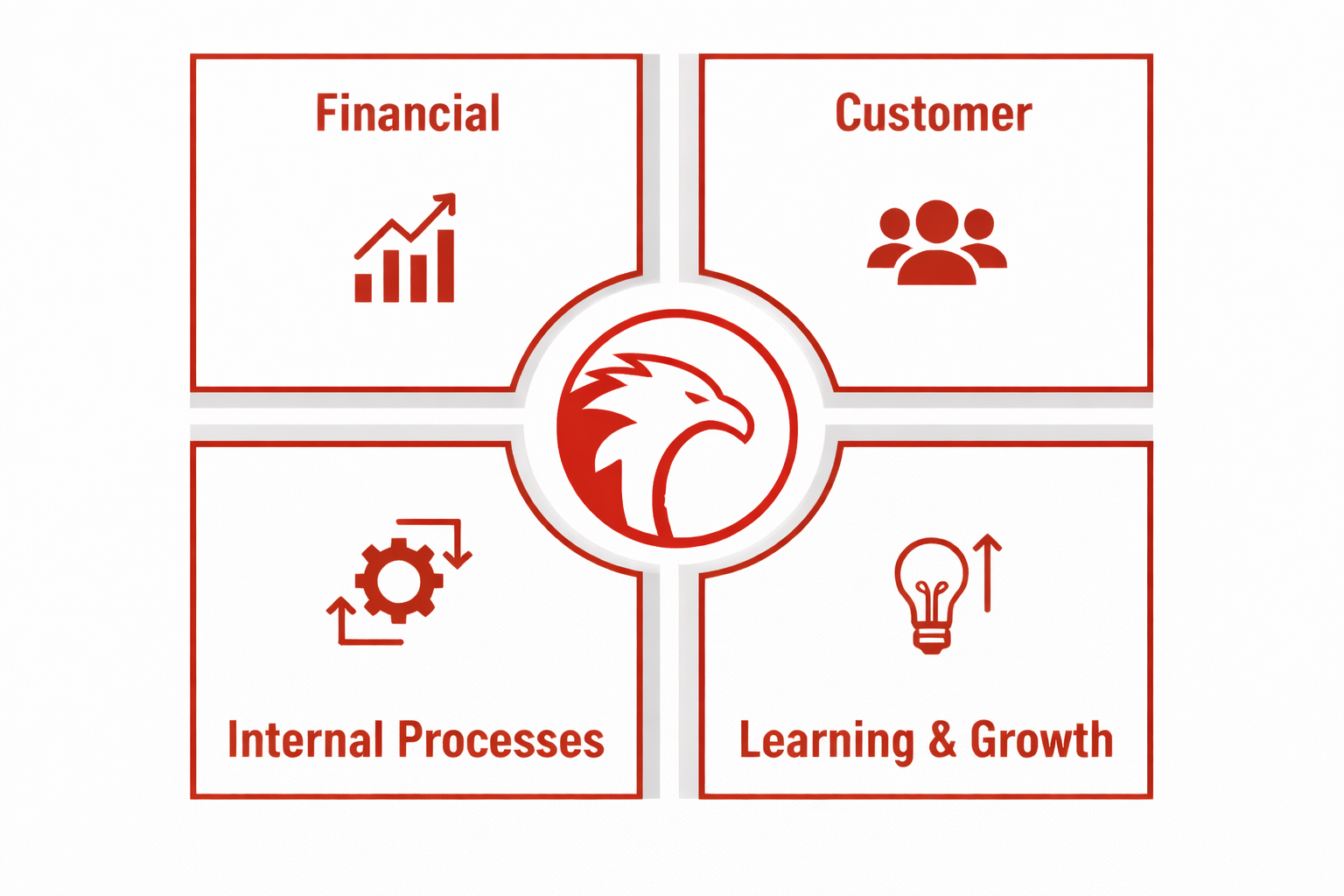
Resurgence Advisory - Balanced Scorecard (BSC) Performance Metrics | Business Analytics
Growing a business through mergers and acquisitions adds immediate layers of complexity. Leadership attention typically flows toward the highest-priority structural concerns—capital structure, local financing arrangements, the revised reporting hierarchy, and the new authorization matrix. These are necessary and urgent. But beneath them lies a subtler and equally important challenge: how does an organization ensure that the strategic thesis behind the acquisition—the reason the deal was done in the first place—does not become diluted or lost in the transition?
In some transactions, the acquired business operates with as much rigor and discipline as the acquirer, or more. In others, significant operational gaps emerge quickly. In both scenarios, leadership needs a sharp, consistent lens to see what is happening across locations and act on it decisively. The Balanced Scorecard provides a cascading lens that provides your team a cross-organizational focus.
KEY TAKEAWAYS
• A cascading Balanced Scorecard connects corporate strategy to business unit targets, departmental KPIs, and front-line execution—ensuring every level of a multi-location organization pulls in the same direction.
• Information flows three ways—down through strategic direction, up through operational results, and across through shared learnings—breaking silos and enabling faster, more informed decisions.
• For companies in M&A—whether buyers integrating acquisitions or sellers preparing for a transaction—a well-cascading BSC reduces integration risk, strengthens valuation, and demonstrates operational maturity to the market.
The Challenge of Aligning Distributed Operations
When a business operates across multiple locations, business units, or geographies, the gap between strategy and execution widens. Corporate leadership may define the direction clearly—but the message can fragment as it passes through layers of management, crosses cultural boundaries, or encounters the competing priorities of day-to-day operations.
Business Analytics and Business Intelligence can make this problem worse before it makes it better. The availability of data has never been greater. But data without structure creates noise, not clarity. What matters more than the volume of information are the questions being asked of it—and whether those questions are consistently aligned to strategic objectives at every level of the organization.
The Balanced Scorecard solves this not by adding more reporting, but by creating a structured cascade—a framework where strategic intent flows downward into measurable targets, and operational reality flows upward and across, creating a complete and connected performance picture.
The Balanced Scorecard Cascading Framework
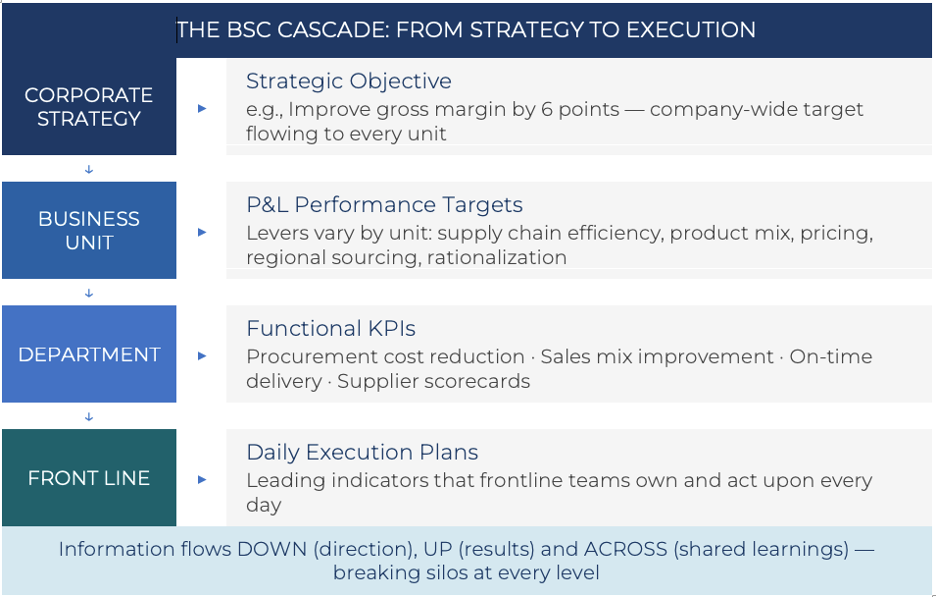
How the Cascade Works: Direction, Results, and Learning
The BSC’s cascading framework operates across two dimensions simultaneously. The first is vertical: strategic objectives flow down from corporate leadership through business unit P&L structures to departmental KPIs and ultimately to front-line execution plans. The second is horizontal: business units and departments share learnings, compare performance, and apply best practices across the organization.
These two directions of flow—vertical and horizontal—operate at the same time. Together they accomplish something that neither directional reporting alone can achieve: they destroy the silos that form naturally in distributed organizations.
Consider a company with a strategic objective to improve gross margin by six points—as was the case at Manitex International, a global crane and lifting equipment manufacturer operating across multiple countries. At the corporate level, the target is clear. But the levers available to achieve it vary significantly from one business unit to the next. In Manitex’s case, those levers included supply chain efficiency, product mix optimization, regional sourcing strategy, pricing adjustments, and product rationalization.
What made the cascading BSC particularly powerful in that environment was that Manitex had established supplier relationships across Europe, the United States, and Asia—yet the regional sourcing teams were not collaborating or sharing intelligence. The horizontal flow of information across business units was the missing element. Once the BSC brought those conversations into a shared framework, the sourcing teams began comparing supplier performance, aligning procurement strategies, and identifying cost reduction opportunities that no single unit could have captured working independently.
That is the real power of the cascade. It does not simply push targets down the organization. It creates a complete operational snapshot that catches issues early, enables faster course correction, and builds the kind of collaborative discipline that sustains performance over time.
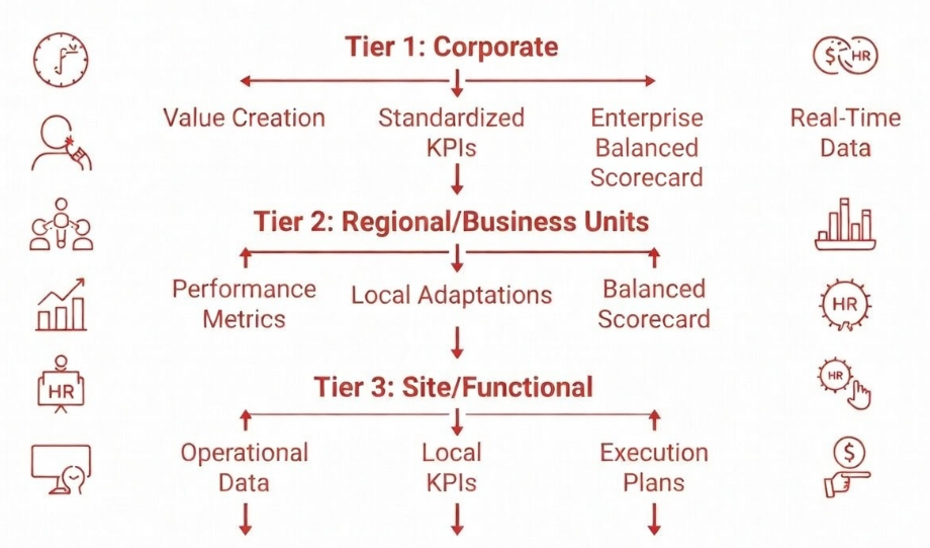
Figure 2: Multi-directional information flow in a cascading BSC environment
Value Creation Through Multi-Location Alignment
Organizations that successfully implement this framework are demonstrating something important: that their people, processes, and technology are working together and maturing. This operational coherence translates directly into value creation—for the business, its leadership, and ultimately for investors or acquirers.
The specific benefits of a well-cascading BSC in a multi-location environment include:
• Clarifying key areas of focus, so every level of the organization understands what matters most and why.
• Accelerating the speed of implementation, because alignment replaces guesswork and competing priorities.
• Enabling apples-to-apples benchmarking across locations—so high performers are recognized, and underperformers can be supported with specificity rather than assumption.
• Creating organization-wide visibility that supports better resource allocation, best practice sharing, targeted interventions at underperforming sites, and more effective board and leadership reviews.
The Manitex example illustrates each of these benefits concretely. With consolidated data flowing from multiple ERP systems into a unified digital dashboard, the company moved from monthly and quarterly reporting cycles to weekly visibility. Managers could see how decisions made today were shaping outcomes this week—and frontline employees, for the first time, could clearly see how their daily actions influenced production velocity, product reliability, customer satisfaction, and ultimately profitability. That clarity changes behavior. And changed behavior, sustained over time, produces record results.
M&A Readiness: What the BSC Signals to Buyers and Acquirers
A cascading BSC does more than improve internal performance. It sends a powerful signal to the market—whether that market is a strategic buyer, a private equity sponsor, or a capital partner evaluating a potential investment.
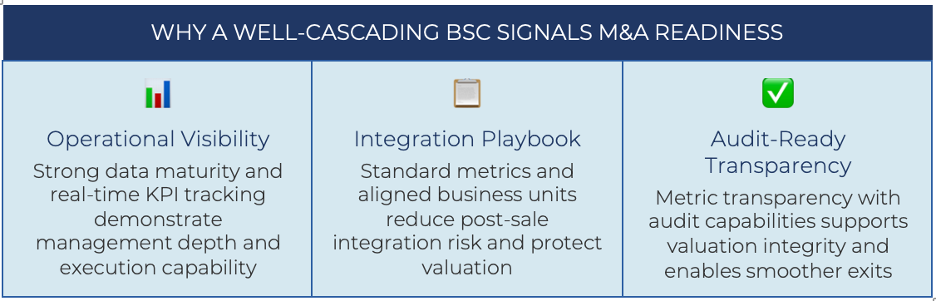
For sellers, a well-cascading BSC demonstrates the three characteristics that buyers prize most: management depth, operational scalability, and data-driven decision-making. It answers the due diligence questions before they are asked. It reduces the friction and uncertainty that drive risk-adjusted discount rates. And it supports the valuation thesis that a well-run organization commands.
For acquirers, inheriting a BSC-aligned business unit dramatically reduces integration complexity. There is already a common performance language in place. Metrics are defined and trusted. The reporting infrastructure exists. The playbook is written. Integration begins from a position of clarity rather than chaos.
Final Thought: Alignment Is Not an Accident
Multi-location organizations do not achieve alignment passively. It requires a deliberate architecture—one that connects strategic intent to daily behavior, enables information to flow freely in all directions, and provides leadership with a real-time view of what is working and what is not.
The Balanced Scorecard, cascaded with discipline and supported by digital analytics, is that architecture. It does not impose rigidity on local teams. It gives them a shared framework within which local excellence can thrive—and within which the strategic value of the whole becomes greater than the sum of its parts.
Whether you are managing a multi-location business today, integrating a newly acquired operation, or preparing your organization for a future transaction, the cascade is where strategy meets execution. And execution, consistently delivered, is where value is created.
About Resurgence Advisory
The team at Resurgence Advisory has completed 38 M&A transactions and uses advanced business analytics, digital dashboards, and Balanced Scorecard frameworks to drive measurable performance improvement. With over 30 years of experience, we help organizations turn multi-location complexity into strategic clarity—and strategy into measurable results.
If you are preparing for a transaction, navigating post-merger integration, or seeking to implement a digital Balanced Scorecard across your locations, we can help. Contact us for a free consultation:
linkedin.com/company/resurgenceadvisory · www.resurgenceadvisory.com
Schedule a free consultation here: https://www.resurgenceadvisory.com/appointments